
Meaningful activities for dementia
Start with the person, not the activity.
If you've ever searched for activities for someone living with dementia, you've probably found plenty of lists.
Puzzles. Colouring. Bingo. Crafts. Reminiscence activities. Music. Games.
Some of those ideas may be wonderful, but there's a problem with starting with a list.
The person you're caring for isn't interested in something because they have dementia.
They're still the person who loved gardening. Or cars. Books. Cooking. Football. Fashion. Fishing. Music. Animals. Working with their hands.
So when you're wondering "What can I get them to do?", try starting somewhere different. Start with the person.


Why lists of dementia activities only get you so far
There isn't one set of activities that people with dementia enjoy.
Think about a group of people who don't have dementia. One person would happily spend an afternoon gardening. Another would rather watch football. Someone else might read, knit, work in the shed, bake a cake or play music.
A diagnosis of dementia doesn't suddenly give all those people the same interests.
That means an activity can be perfectly suitable for someone living with dementia and still be completely wrong for the particular person in front of you.
The question is not, "What activities are good for dementia?"
Try asking yourself, "What might be meaningful to this person?"
Think beyond hobbies. Consider the person's work, routines, roles and everyday life as well as the things they did for pleasure.
Were they a teacher? A builder? A nurse? A parent who cooked for a large family? Someone who always had a beautiful garden?
Did they repair things? Follow a particular sport? Love clothes? Go fishing? Read constantly? Keep pets? Spend every weekend baking? Enjoy dancing?
Think about the ordinary things too. Someone doesn't need to have called something a hobby for it to have been an important part of their life.
A former office worker may respond to familiar stationery or paperwork. Someone who spend decades caring for someone at home may enjoy folding towels, arranging flowers or sorting familiar household objects.
Look for the strengths that are still there
It's easy to approach dementia by noticing what is lost.
Memory becomes less reliable. And planning and problem-solving can become harder. Something that once semed straightforward may become difficult when it requires several steps, choices or instructions.
But loss isn't the whole picture.
Dementia educatory, Judy Cornish, creator of the DAWN Method, encourages caregivers to pay attention to the abilities a person can still use, rather than focusing only on the rational-thinking and memory skills they are losing.
One of the ideas I find particularly useful in Judy's approach is the distinction between rational and intuitive thinking.
As rational thinking becomes more difficult, intuitive thinking becomes increasingly important.
A person may struggle to work something out logically, follow a sequence of instructions or explain why they know something, while still responding to what feels familiar, comfortable, beautiful, funny or enjoyable.
That matters when we're thinking about activities that can occupy someone or give them something meaningful to focus on.
Rather than ask the person to think their way through something, we can simply give them something to respond to.
A beautiful flower
A familiar song
A joke that makes them laugh
The feel of wool in their hands
A photo of an old car
A cake that looks delicious.
The response doesn't have to involve explaining, remembering or getting an answer right.
Think about what can be done almost automatically
Another useful idea from Judy's approach is the difference between doing something mindfully or automatically.
Think about all the things you do without consciously working through every step.
When you've done something hundreds or thousands of times, your hands can sometimes seem to know what to do without you having to stop and think about it.
A familiar action may be easier than an activity that requires them to understand new instructions, hold several pieces of information in mind and decide what to do next.
This is another reason someone's life history matters.
A person who spent decades folding laundry, sorting objects, reading, handling tools, singing, gardening, playing cards or doing other familiar tasks may still respond to aspects of those activities even when doing them in the old way has become difficult.
We aren't trying to recreate everything they once did. We're looking for ways of participating that place fewer demands on the abilities that have become difficult.
The present can still be enjoyable
Memory isn't required for enjoyment. Someone may not remember this afternoon that you sat together this morning. That doesn't mean that the morning didn't matter.
They may enjoy a song without remembering its title.
They may laugh at a joke and forget it soon afterwards.
They may enjoy looking at a bird, eating something delicious, holding your hand, singing, arranging flowers or sitting the sunshine.
The enjoyment is happening now.
Can they enjoy this while it's happening?
And instead of judging an activity by what the person remembers, we can pay attention to what is happening in the present.
Then ask what they can enjoy now
Interest
Pleasure
Participation
Comfort
Laughter
Conversation
Singing
Curiosity
Or simply being peacefully absorbed in something pleasant for a while. That matters too.
This is where things can become difficult for families.
Someone may have loved an activity all their life but no longer be able to do it in the same way.
Perhaps Mum/Mom was a wonderful knitter, but she can no longer follow a pattern.
Dad may have maintained his own care but can no longer use tools safely.
Someone who read novels every day may struggle to follow a long story.
That doesn't necessarily mean the interest itself has disappeared.
It may be the demand of the activity that have become too difficult. Eyesight and dexterity may have declined too...but some of these aspects of an activity can be addressed.
Instead of asking whether the person can still do the hobby, ask:
What parts of this might they still enjoy?
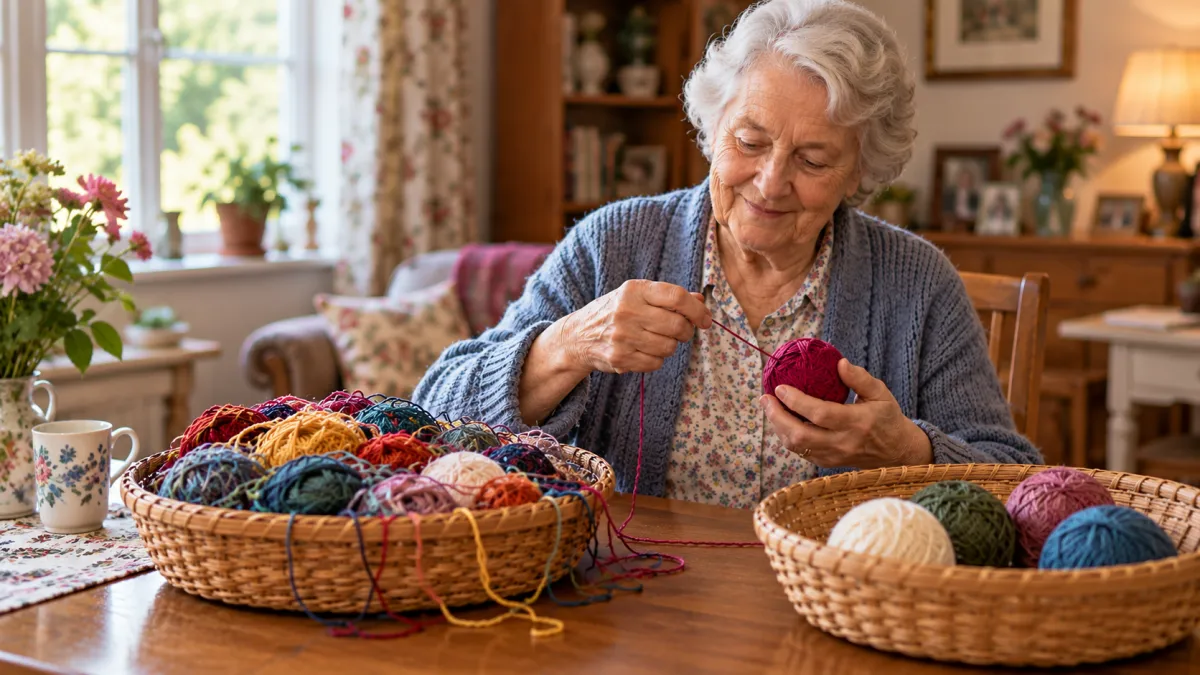
For someone who knitted, that might be handling wool, sorting colours, winding yarn or looking at familiar knitting items.
For someone who loved cars, it might be looking at photographs of classic cars or talking about something they notice.
For a lifelong reader, it might be a joke, a short poem, a familiar phrase or a small amount of a large-print text rather than a whole book.
You are keeping the interest while changing the way the person can take part.
Make the activity simpler, not childish
An activity can become easier without become child-like. Often, relatively small changes can make a big difference.
Not sure what to try?
Download my free guide, 5 Activities That Actually Work for People With Dementia, with practical ideas you can try at home or in care.
Set up for success
Make sure the object they will be handling is safe, without sharp edges or points.
If you're going to invite the person to read, ensure the text is large and clear enough for their eyesight.
Clear a table of other objects, so the person can focus. Ensure there is enough contrast between any items on the table, or to be placed on the table, and the item itself. A placemat, tablecloth or tray in a contrasting colour can help.
Anticipate difficulties or discomfort. This might mean cleaning their glasses, ensuring the person is not too hot or cold and is sitting in a comfortable seat.
Present less at once
A table covered with 20 cards may be confusing. Two or three might be manageable.
A worksheet containing 20 questions may be overwhelming. One question on a card at a time, may not.
You can always add more.
Give the person something to hold
It often helps to put an object directly into the person's hands.
Instead of expecting them to work out what they're supposed to do from everything sitting on a table, they have one thing to focus on now.
This is why many Sylvia's Heart activities use individual cards rather than crowded worksheets.
Demonstrate instead of explaining
Long verbal instructions can make an activity harder than it needs to be.
If you're matching pictures, make one match yourself. Invite the person to help you.
If you're sorting objects, place the first one where it belongs. Then offer the person another, and ask them if they can help you.
Sometimes showing is much easier than explaining.
Adjust as you go
You don't have to decide in advance that someone is capable of six pairs but not ten.
Start small and watch what happens.
Add more if they're enjoying it. Make it simpler if they seem uncertain. Stop if they've had enough.
The activity should adapt to the person. The person shouldn't have to adapt to the actvity.
Don't turn familiarity into a memory test
Familiar things can be wonderful starting points for interaction. But it's very easy to turn them into questions.
You show someone a picture of an old car:
"Do you remember these?"
You put on a familiar song:
"Who sang this?"
You show them a cake in a magazine:
"Didn't your mother used to make this?"
Those questions may seem like natural conversation starters, but they also require the person to retrieve information.
If they can't, a pleasant activity can suddenly feel like a test.
You don't need a question to being a conversation. You can simply say:
"That's a beautiful car."
"I love this song."
"That cake looks delicious."
Then leave some space. The person may respond. A memory may emerge. A story may follow. If it does, wonderful.
But, they don't need to remember something for the moment to have value.
The value can be in the experience happening now. The joy, the beauty and the connection.
Follow what happens
This may be the most important part.
Imagine you planned a reading activity.
You hand the person a card about a garden bird. They read a few lines, look at the picture and suddenly start talking about the dog they once had.
What do you do?
Listen to them talk about the dog.
Don't say:
"We'll talk about that later. Let's finish reading about the birds."
The bird card has already done something useful. It gave the two of you somewhere to begin.
The same thing can happen with music. You planned to read some popular phrases and the person starts singing.
Sing.
You planned to match pictures of fashion clothing and the person starts sorting them in a completely different way.
See what they're doing.
You offer an activity and they clearly aren't interested.
Put it away for today.
The purpose isn't to successfully deliver the activity you planned. The purpose is the person in front of you.
What counts as a successful dementia activity?
It's tempting to measure success by completion.
We answered all the questions. We finished the crossword. We matched all the items. We finished the puzzle.
But those aren't necessarily the most useful measures. Perhaps you offered ten cards and used only two.
But the second card led to 10 minutes of enjoyable conversation.
Perhaps someone didn't answer the trivia question correctly, but laughed with everyone else.
Perhaps they didn't read the card but spent several minutes looking closely at the photograph.
Perhaps you started playing music and they tapped their foot.
Perhaps you folded three towels together.
Perhaps nothing much happened at all but you sat comfortably beside each other.
And if someone enjoyed an experience while it was happening, forgetting it later doesn't erase the enjoyment they had in that moment. Those moments count.
Connection can be the activity.
Dementia activity ideas based on the person
If you're not sure where to start, think about interests and familiar parts of the person's life rather than looking for something labelled specifically as a dementia activity.
📚 For someone who loves reading
Try:
short large-print passages
familiar sayings and phrases
jokes
poetry
song lyrics
familiar book titles
short articles about a favourite subject
A whole novel may have become difficult while reading itself can still be enjoyable.
🎵 For someone who loves music
Try:
listening to familiar songs (you'll need to find out or work that out)
singing together
reading a familiar lyric
watching a performance
playing an instrument
tapping or moving to the rhythm
choosing between two pieces of music
You need to ask for the singer's name or when the song was released. You can simply enjoy it together.
🌿 For someone who loves nature or gardening
Try:
looking at photographs of flowers or birds
arranging flowers
watering plants
sorting seed packets
handling safe gardening objects
sitting outside together, noticing the surrounds
looking through a gardening magazine
A former gardener doesn't necessarily need to be able to garden independently for plants and nature to remain enjoyable.
🥘 For someone who loves cooking or food
Try:
looking through recipes
sorting familiar kitchen objects (not knives, perhaps!)
looking at photographs of favourite foods
simple food preparation where appropriate
setting the table
folding tea towels
reading about familiar cakes and desserts
Food can give you plenty to enjoy without asking someone to remember recipes or perpare an entire meal.
🔧 For someone who enjoys practical work
Try:
familiar tools or photographs of tools
sorting safe objects
matching tools with familiar tasks
workplace photographs
simple purposeful jobs
folding, organising or arranging things
A former builder, mechanic, farmer, nurse teach and office worker may respond to completely different things.
🏀 For someone who loves sport
Try:
photographs of favourite sports
familiar equipment
watching old games or highlights
reading sports-related words
sorting or matching pictures
looking through sporting magazines or books
Again, you don't need to turn it into trivia. Let the sport provide the interest.
👗 For someone who enjoys clothes and fashion
Try:
looking through fashion photographs
handling scarves or other safe accessories
sorting items by colour or type
matching pictures
choosing between two colours
looking at clothing from an era they enjoyed
The activity might become a conversaion - or the person may simply enjoy the colours and objects. Both are fine.
Looking for something ready to use?
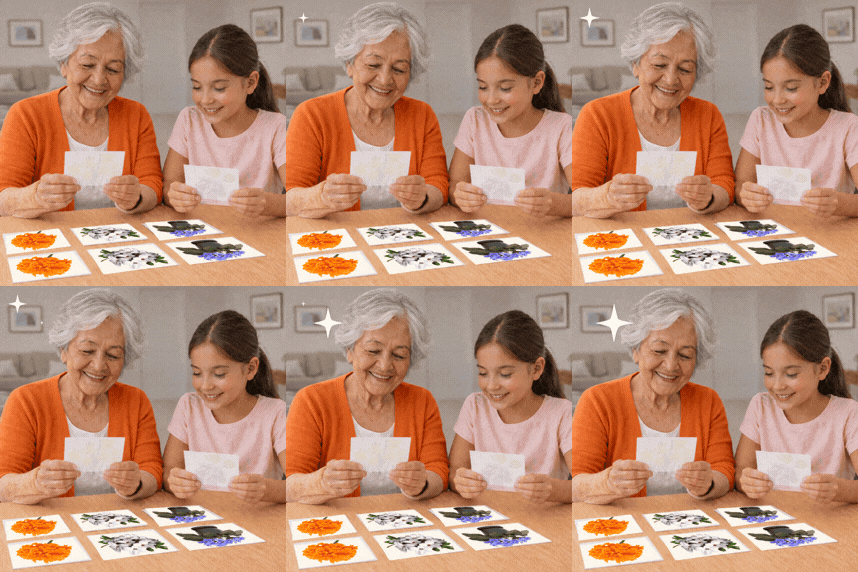
Explore printable dementia activities for reading, matching, sorting, music, familiar interests and more.
What if they don't want to do anything?
Don't assume that refusing an activity means the person no longer has interests.
There can be many reasons an activity doesn't work at a particular moment.
It may be too complicated
There may be too many distractions around them
They may not understand what you're asking
There may be too many choices
They may be tired
Or they may not simply want to do that activity today.
Try reducing the demand.
Instead of:
"Would you like to do this sorting activity"
You might sit beside them, put one interesting card in their hands and invite them to help you sort it into the right category.
Sometimes the answer really is not now.
That's okay too.
You don't need to keep someone busy every minute
Meaningful enagement isn't the same as having a full activity schedule.
Having a cup of tea together can be meaningful.
Listening to music can be meaningful.
Folding laundry together can be meaningful.
Looking out the window can be meaningful.
Sitting beside someone you love can be meaningful.
There will also be times when the person doesn't need you to create an activity at all. The goal isn't constant stimulation.
It's finding ways for the person to participate, enjoy, contribute or connect when they wan and are able to.
A simple place to begin
The next time you're wondering what to do with someone living with dementia, try asking these three questions:
1. Who is this person? What have they enjoyed, valued, done and cared about throughout their life?
2. What can they comfortably engage with today? Not what could they do five years ago or even yesterday.
3. How can I make participation easier? Less information? Fewer choices? Something to hold? A demonstration? Some help?
Then try something. Watch the person and let their response tell you what happens next. You don't have to get through the activity. You don't have to produce a memory, and you don't have to make every moment meaningful. Sometimes you just need somewhere to begin together.
Start with the person. Follow their response. Find out what they can enjoy today.

Want a collection of activities to choose from?
The Caregiver Confidence Kit includes 18 printable dementia activity sets plus guidance to help you introduce and adapt activities to the person you're supporting.