
1950s Toys – Printable Dementia Reading Activity
$7.00
Quantity
A Slinky. A toy train. A Hula Hoop. A View-Master.
For someone who grew up in the 1950s, familiar toys can provide an easy and enjoyable place to begin.
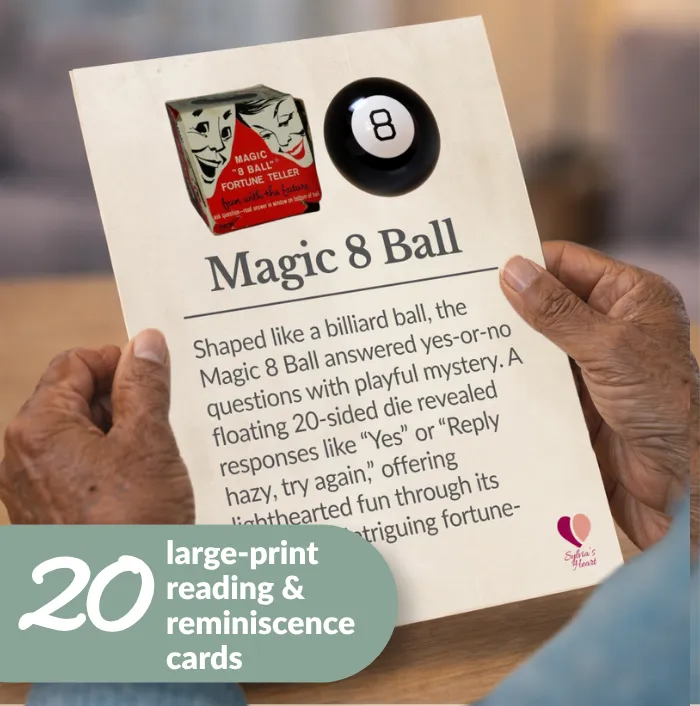
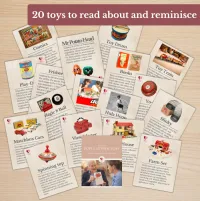
1950s Toys is a printable dementia reading activity featuring 20 familiar toys, each presented on its own large-format card with a picture and short, easy-to-read text.
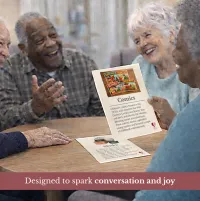
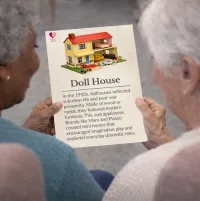
Offer one card at a time and let the person hold it.
They might read it aloud. Look closely at the picture. Comment on the toy. Laugh at something in the description. Or the card might lead to a completely different conversation.
They don't have to remember owning the toy for the activity to work.
Who might enjoy 1950s Toys?
This activity may suit someone who:
grew up around the 1950s
enjoys familiar objects from earlier decades
still enjoys reading
responds well to pictures
finds long passages or busy activity sheets difficult
likes having something tangible to hold
enjoys quiet one-to-one interaction
It's also an easy activity to use across generations. A younger family member may never have seen some of these toys before, giving both people something to look at and talk about together.
20 familiar toys to explore
The set includes:
Spinning Top · Matchbox Cars · Doll House · Toy Train · Magic 8 Ball · View-Master · Barbie · Slinky · Farm Set · Yo-Yo · Hula Hoop · Frisbee · Play-Doh · Toy Drum · Comics · Mr Potato Head · Lego · Snakes and Ladders · Yahtzee · Books
Each toy has its own card with a large image and easy-to-read text.
The cards are designed to be held and read, rather than presented as a worksheet to complete.
How do you use the cards?
Choose a card you think the person might enjoy and place it in their hands.
You might simply invite them to read what's on the card.
Then give them time.
There's no need to ask:
“Do you remember this?”
“Did you have one of these?”
or
“What toys did you play with as a child?”
A memory might emerge naturally. If it does, follow it.
But no remembered story is required for the activity to have been worthwhile.
Why individual reading cards?
Having one toy on an individual card keeps the activity simple.
Rather than confronting the person with a whole page of questions or several things demanding their attention, you can offer one interesting object, one picture and one short piece of text.
The card also gives them something concrete to hold.
Use one card or several. Return to favourites. Read the words aloud yourself if that's more comfortable for the person.
There is nothing to finish.
Inspired by a Montessori approach to dementia care
This activity was inspired by the work of Tom and Karen Brenner, whose dementia reading activities use large-print individual cards as a way of supporting remaining reading abilities while creating opportunities for social interaction and connection.
The Brenners also describe the value of giving someone a physical card to hold rather than asking them to produce an answer with nothing in front of them.
That idea runs throughout this activity.
Something familiar to look at. Something concrete to hold. Something accessible to read.
And then you follow the person.
What if the person doesn't want to read?
That's okay.
You can read the card aloud.
They may prefer to look at the picture.
You might comment on something you notice about the toy or simply offer another card.
If they're not interested, put the activity away and try something else.
The aim isn't to get through all 20 toys.
Connecting is the game.
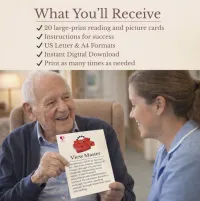
What's included?
You'll receive:
20 printable 1950s toy reading cards
a large image of a familiar toy on each card
large, easy-to-read text
caregiver instructions
US Letter PDF
A4 PDF
instant digital download
Print the cards and reinforce, laminate or place them in plastic sleeves if desired for repeated use.
Use at home or in dementia care
1950s Toys can be used:
one-to-one
during family visits
at home
in aged care and memory care
in small groups
by activity staff and professional caregivers
It's particularly useful when you're not quite sure what to do together.
Choose a toy. Put the card in the person's hands. See where it takes you.
What caregivers say
“My residents loved this product!”
“Our residents absolutely loved it.”
“I appreciated that they were full letter size pages making the print larger.”
“Puts a smile on the faces of seniors.”
You may also like
Customer Reviews

Write a review
Be the first one to review this product

© 2026 | Powered by Freedomkit.ai