

Baseball Word & Picture Match – Printable Dementia Activity
$7.00
Quantity
For someone who has always enjoyed baseball, familiar baseball words and images can provide a natural starting point for an activity together.
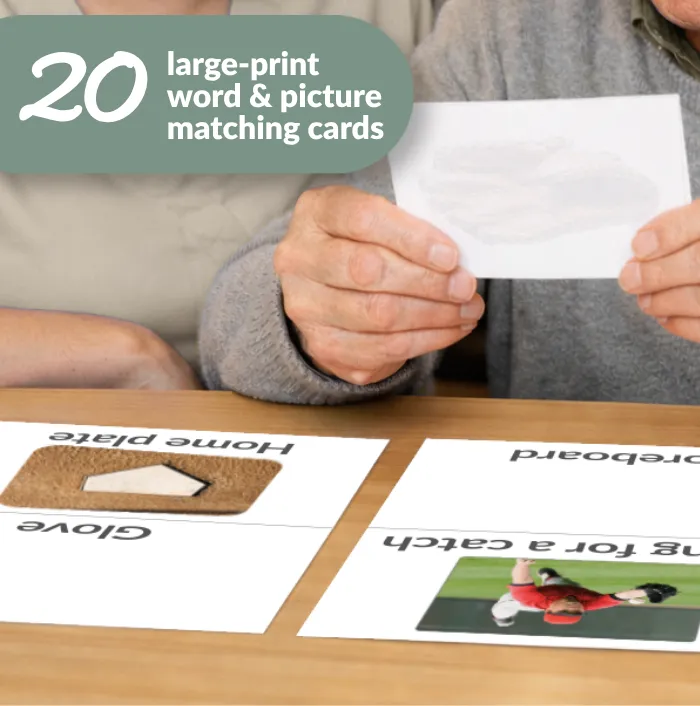
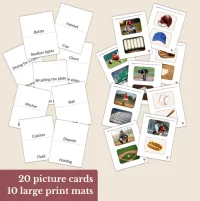
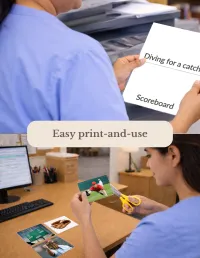
Baseball Word & Picture Match is a printable dementia activity using 20 baseball picture cards and 10 large-print word mats.
The person matches pictures of familiar baseball objects and actions with their written names.
But matching doesn't have to be the only way to use it.
You can offer just a few pictures, read the words together, look at the images, talk about baseball—or simply follow wherever the person's interest takes you.
The aim isn't to test what they remember. It's to give them something familiar they can engage with now.
Who might enjoy this activity?
This activity may suit someone who:
has an interest in baseball
enjoys looking at sports photographs and images
can still read familiar words
enjoys matching pictures and words
finds a whole worksheet or complicated game difficult
benefits from activities that can be simplified and presented a little at a time
You don't need to know how much the person remembers about baseball.
Interest is enough reason to try it.
How does Baseball Word & Picture Match work?
The set contains 20 baseball picture cards and 10 large-print word mats.
Each word mat contains two baseball words, with two corresponding picture cards to match to the written words. These include familiar baseball objects and actions—for example, equipment used in the game as well as actions such as brushing the plate.
For example, the person looks at the large-print words and places each picture with the word it represents.
Because the materials are separate, you don't need to present all 20 pictures at once. You can begin with one word mat and its two matching pictures, making the activity much simpler to follow.
If that's comfortable, introduce another mat and more pictures.
This gives the caregiver control over the amount of information presented and makes it easy to adapt the activity to the person's capacity on that particular day.
Start with less
You don't need to put the entire activity on the table.
Try beginning with one word mat and the relevant pictures, or a small selection of cards.
Show the person what to do rather than giving a long explanation.
If they're comfortable and enjoying it, you can gradually introduce more.
Give the person something to work with
The separate picture cards can be picked up, moved and placed.
That makes this different from completing a page of exercises. The caregiver can control what is presented and adapt the activity as they go.
If lots of cards become confusing or distracting, use fewer.
If the person is managing easily and wants more, add more.
The activity adapts to the person—not the other way around.
What if matching is difficult?
They don't have to complete the matching activity for the materials to be useful.
You might:
show one baseball picture at a time
read a word aloud together
offer a choice between two pictures
ask which picture they like
talk about something they notice in an image
let the person handle and look through the cards
follow a conversation if one begins
There's no need to ask, “Do you remember this?”
And if a match isn't correct, you don't need to correct it.
Connecting is more important than completing the activity.
Why baseball?
Activities are more likely to invite someone's attention when they connect with something that matters to that particular person.
For a baseball fan, the familiar shapes, equipment, actions and vocabulary of the game can provide that starting point.
That doesn't mean you need to quiz them about players, teams, dates or games they once watched.
The baseball theme gives you something familiar to look at, read, handle and talk about together.
Inspired by a strengths-based approach to dementia activities
This activity was designed around the abilities a person may still be able to use—such as reading familiar words, recognising images, handling cards and matching—rather than beginning with what dementia has taken away.
The use of large, readable words and physical cards also reflects ideas used by dementia educators Tom and Karen Brenner, whose Montessori-inspired activities use reading materials and cards that participants can physically hold and work with.
The purpose isn't to exercise someone's memory or measure their performance.
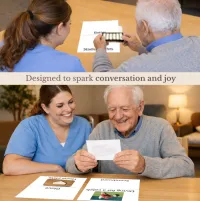
It's to make it easier for the caregiver to find a way for the person to participate.
What's included?
20 baseball-themed picture cards
10 large-print word mats
baseball equipment and action images
caregiver instructions
US Letter PDF
A4 PDF
instant digital download
Simply print and prepare the cards following the included instructions.
Where can I use it?
Baseball Word & Picture Match can be used in:
aged care and memory care
one-to-one activity sessions
small groups
home care
family visits
You might spend twenty minutes matching pictures—or five minutes looking at one card that catches someone's attention.
Both can be a successful activity.
You may also like
Customer Reviews

Write a review
Be the first one to review this product

© 2026 | Powered by Freedomkit.ai