

Classic Cakes & Desserts – Printable Dementia Reading Activity
$7.00
Quantity
Apple pie. Trifle. Banana splits. Pineapple upside-down cake. Rice pudding.
Sometimes a familiar food is enough to give you something to enjoy together.
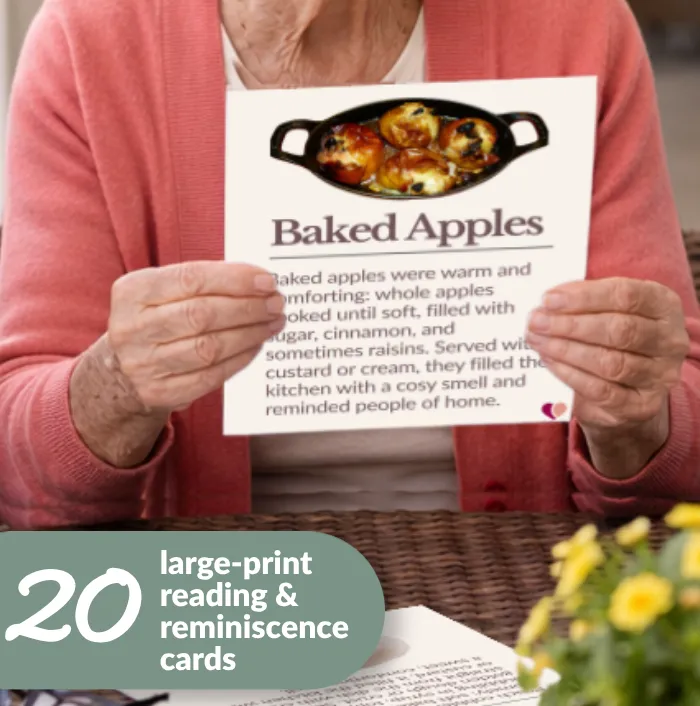
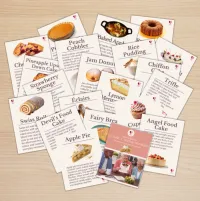
Classic Cakes & Desserts is a printable dementia reading activity featuring 20 individual cards, each with a large image of a familiar cake or dessert, its name, and a short, easy-to-read description.
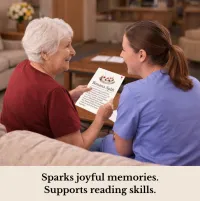
Offer one card at a time for the person to hold and read—or read it aloud together.
There's nothing they need to remember and no quiz to get right.
The cake or dessert simply gives you something familiar to look at, read and perhaps talk about together.
Who might enjoy Classic Cakes & Desserts?
This activity may suit someone who:
has enjoyed baking, cooking or food
likes cakes and desserts
still enjoys reading
finds long passages or busy pages difficult
responds well to having something tangible to hold
enjoys looking at attractive food images
benefits from activities that can be offered one piece at a time
They don't need to have baked these desserts themselves.
They don't need to know when they were popular.
And they don't need to tell you a story about them.
Enjoying the card in front of them is enough.
What's on the cards?
The set includes 20 classic cakes and desserts, including:
Banana Split, Apple Pie, Devil's Food Cake, Cupcakes, Fairy Bread, Angel Food Cake, Swiss Roll, Éclairs, Trifle, Lemon Meringue Pie, Jam Donuts, Strawberry Sponge, Baked Apples, Pineapple Upside Down Cake, Peach Cobbler, Cherry Tart, Rice Pudding, Rum Cake, Chiffon Cake and Pumpkin Pie.
Each card combines:
a large, clear food image
the name of the cake or dessert
a short piece of easy-to-read text
The descriptions talk about the food itself and some of the everyday experiences associated with it—such as afternoon tea, family gatherings, bakeries, celebrations and eating together.
How do you use the cards?
You don't need to put all 20 cards in front of the person.
Choose one and place it in their hands.
You might invite them to read it:
“Would you kindly read what's on the card to me?”
If reading independently is difficult, you can read the card aloud instead.
Then see what happens.
They may want another card. They may comment on the picture. They may start talking about food or baking. They might tell you something entirely different.
Follow the person rather than trying to get through the set.
Why individual cards rather than a book or worksheet?
The individual-card format is deliberate.
Instead of presenting a page filled with different things to read, the caregiver can offer one self-contained piece at a time.
The person has something physical to hold and one image and piece of text to focus on.
It also means you can easily adapt the activity.
Use one card. Use three. Choose only the desserts you think will interest the person. Stop when they've had enough.
There's no requirement to “finish” the activity.
The card in the person's hands is what's happening now.
Don't make the food a memory test
A familiar dessert may prompt a memory or story.
If it does, wonderful.
But that isn't something you need to make happen.
Rather than:
“Do you remember making these?”
or
“Didn't your mother used to make this?”
you might simply comment on what you're looking at:
“That looks delicious.”
“I love the look of that one.”
Or let the person lead.
A conversation about the past may emerge naturally. Or you may simply spend a few pleasant minutes looking at cakes together.
Both are worthwhile.
Inspired by Tom and Karen Brenner's approach
Classic Cakes & Desserts was inspired by the work of dementia educators Tom and Karen Brenner, whose Montessori-inspired approach uses large-print reading materials and individual cards that people can physically hold.
Their activities are designed around abilities that may still be available and use familiar material as a way to create participation and connection.
That approach is reflected throughout this activity: something readable, something familiar and something concrete to hold.
What's included?
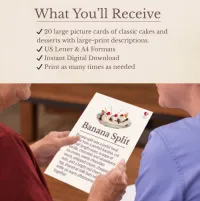
You'll receive:
20 individual Classic Cakes & Desserts reading cards
a large image on every card
cake or dessert name
short, easy-to-read descriptive text
instructions for preparing and using the activity
US Letter PDF
A4 PDF
instant digital download
The cards can be laminated for repeated use or placed in plastic sleeves. They can also be mounted on thicker card if that makes them easier for the person to handle.
Use at home or in dementia care
Classic Cakes & Desserts can be used:
one-to-one
during family visits
at home
in aged care and memory care
in small groups
by professional caregivers and activity staff
One person might happily read all 20 cards.
Another might spend ten minutes with one picture of apple pie.
The number of cards completed isn't the measure of a good activity. The experience you have together is.
You may also like
Customer Reviews

Write a review
Be the first one to review this product

© 2026 | Powered by Freedomkit.ai