
Garden Birds – Printable Dementia Reading Activity
$7.00
Quantity
A beautiful bird at the feeder. A familiar song outside the window. The flash of colour of a bird you've seen many times before.
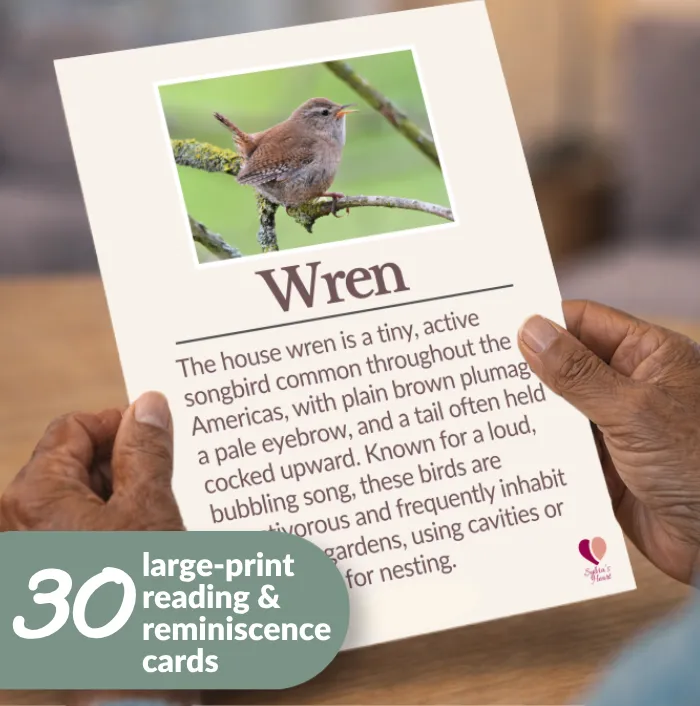
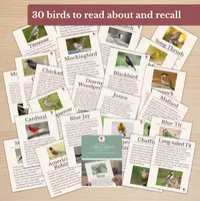
Garden Birds is a printable dementia reading activity featuring 30 individual bird cards, each with a clear photograph and a short, easy-to-read description.
The cards feature familiar garden birds found across the USA and Eurasia, giving someone who enjoys birds or nature something attractive and interesting to hold, look at and read.
Offer one card at a time.
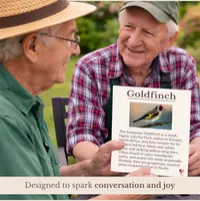
The person might read the description aloud, look closely at the photograph, comment on the bird—or simply enjoy having something interesting in front of them.
There's nothing they need to remember and no quiz to get right.
Who might enjoy Garden Birds?
This activity may suit someone who:
enjoys birds, gardens or nature
has enjoyed birdwatching or feeding birds
still enjoys reading
likes looking at photographs
finds long passages or busy pages difficult
responds well to having something tangible to hold
enjoys quiet one-to-one activities
They don't need to know the name of the bird.
They don't need to identify its species.
And they don't need to remember seeing one before.
The bird in front of them gives you something to enjoy together now.
What's on the cards?
The set contains 30 garden bird reading cards featuring birds found across the USA and Eurasia.
Each full-page card includes:
a clear photograph of the bird
the bird's name
a short description of approximately 40 words
large, easy-to-read text
The short descriptions give the person enough to read without presenting them with a long or complicated page of information.
How do you use Garden Birds?
Choose a card you think the person might enjoy and place it in their hands.
You might simply say:
“Would you kindly read what's on the card to me?”
Then give them time.
They may read it aloud.
They may study the photograph.
They may make a comment about the bird.
They might start talking about something completely different.
Follow them.
If the card has opened a conversation, you don't need to bring the person back to the reading activity just because there are another 29 cards waiting.
Why individual bird cards?
Presenting the birds as individual cards rather than pages in a book gives the caregiver control over the activity.
You can choose one bird at a time, rather than presenting lots of information or choices at once.
The person has something physical to hold and a single photograph and short piece of text to focus on.
Use one card. Use five. Return to favourites another day.
There is no set number to complete.
What if reading has become difficult?
You can read the description aloud instead.
The photograph itself can become the activity.
Look at the colours together. Comment on something you notice. Offer another bird if the person seems interested.
There's no need to ask:
“What kind of bird is this?”
“Do you remember seeing these?”
or
“What birds did you have in your garden?”
A memory or story may emerge naturally—and if it does, follow it.
But the person doesn't need to retrieve a memory for the activity to have been worthwhile.
Inspired by a strengths-based approach
Garden Birds was designed around something a person may still enjoy doing: holding a card, looking at an attractive image and reading accessible text.
The format was influenced by the Montessori-inspired dementia activities of Tom and Karen Brenner, who use large-print reading cards that give the person something concrete to hold and work with.
The bird provides the subject.
The reading card provides a way to begin.
What happens between you and the person from there is more important than finishing the activity.
What's included?
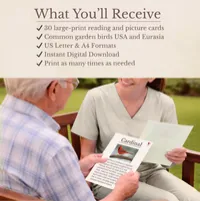
You'll receive:
30 Garden Birds reading cards
birds found across the USA and Eurasia
a clear bird photograph on every card
short descriptions of approximately 40 words
large, easy-to-read text
caregiver instructions
US Letter PDF
A4 PDF
instant digital download
Print the cards and laminate, reinforce or place them in plastic sleeves if desired.
Use at home or in dementia care
Garden Birds can be used:
one-to-one
during family visits
at home
in aged care and memory care
in small groups
by activity staff and professional caregivers
Someone might read ten bird cards.
Someone else might spend five minutes looking closely at one.
And one bird might start a conversation that has nothing whatsoever to do with birds.
That's okay. The card has already done its job.
You may also like
Customer Reviews

Write a review
Be the first one to review this product

© 2026 | Powered by Freedomkit.ai