

Men’s Clothing Picture Match – Printable Dementia Activity
$7.00
Quantity
A shirt, a hat, a familiar pair of shoes.
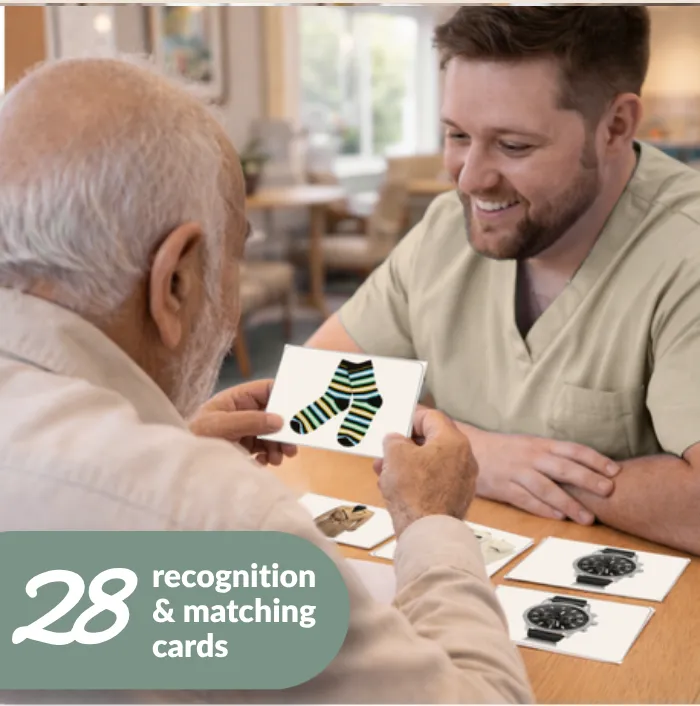
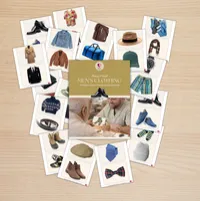
Men’s Clothing Picture Match is a printable dementia activity featuring 28 clear images of familiar men’s clothing.
The cards can be used in different ways. Print two copies to match identical pictures, or use one set to sort clothing by type, such as shirts, hats or shoes.
That means you can make the activity simpler or more challenging depending on the person—and change how you use it from one occasion to another.
There’s no need to remember names, dates or events. The person can simply look, recognise, match, sort and choose.
Who might enjoy this clothing activity?
This activity may suit someone who has an interest in:
clothes and getting dressed
shoes, hats or particular styles of clothing
looking smart or dressing for work
familiar everyday objects
sorting and organising
simple picture matching activities
It may be particularly useful when you're looking for an activity for a man living with dementia but don't want to assume that every man is interested in cars, sport or tools.
Start with who the person is and what catches their interest.
How can the clothing cards be matched and sorted?
There isn't just one way to use the cards.
Match identical pictures
Print the cards twice and choose a small number of pairs.
Place the pictures face up so the person can see them. This isn't a face-down memory game.
You might place one card in front of the person and say:
“Can you help me find one like this?”
Demonstrate a match first if that helps.
Sort by type of clothing
With one set of cards, the person can group similar items together.
For example:
shoes with shoes
hats with hats
shirts with shirts
You don't need to use all 28 cards. Choose a few categories and as many cards as seem comfortable for the person.
Why use pictures of familiar clothing?
Clothing is part of ordinary life.
We choose it, wear it, handle it and see it on other people over many years. Particular types of clothing may also be connected with work, going out, sport, special occasions or simply someone's personal style.
Dementia may make some activities increasingly difficult, while familiar objects can still provide something concrete to recognise and respond to.
The person doesn't need to tell you what an item is called or remember when they wore something similar.
They can engage with what's in front of them.
Give the person something to handle
The cards aren't intended simply to be looked at from across the table.
They can be picked up, moved, compared, grouped and placed together.
This is something I particularly value in the Montessori-inspired work of dementia educators Tom and Karen Brenner. Their activities use cards and familiar categories to give people something concrete to work with, rather than relying on questions and memory recall.
Men’s Clothing Picture Match builds on that approach using clear images of familiar clothing and several possible ways to work with them.
What if matching or sorting is too difficult?
Make it smaller.
Instead of six pairs, try two.
Instead of several types of clothing, put out a few shoes and hats.
Demonstrate what you're doing rather than repeatedly explaining it.
And matching doesn't have to remain the goal.
The person might prefer to look through the pictures, choose something they like or comment on an item.
You could say:
“I like that jacket.”
or:
“Which of these do you like?”
That's very different from testing them with:
“Do you remember having one of these?”
If a conversation develops, follow it. If they're not interested, put the cards away.
The aim isn't to make the activity work. It's to find something that works for this person.
Familiar clothing can open a conversation
Someone may notice a hat that reminds them of a style they like. A shirt might lead to a comment about dressing for work. Shoes might lead somewhere completely unexpected.
Or none of that may happen.
That's fine too.
A remembered story isn't required for the person to enjoy looking, choosing, sorting or matching.
What's included in Men’s Clothing Picture Match?
You'll receive:
28 men’s clothing picture cards
clear images of familiar clothing
cards that can be used for picture matching or sorting by type
caregiver instructions explaining how to introduce and adapt the activity
US Letter PDF
A4 PDF
For identical picture matching, simply print the cards twice.
This is an instant digital download. Nothing will be mailed to you.
You can also print onto heavier card or laminate the cards for greater durability and easier handling.
Using Men’s Clothing Picture Match at home or in dementia care
The activity can be used:
at home with a family member living with dementia
during family visits
for one-to-one engagement
with small groups
in aged care or memory care
by activity coordinators and professional caregivers
You don't need to work through all 28 pictures or use the cards the same way every time.
Match two pairs. Sort a few hats and shoes. Look through the cards together. Talk about something that catches the person's attention.
The activity should adapt to the person — not the person to the activity.
You may also like
Customer Reviews

Write a review
Be the first one to review this product

© 2026 | Powered by Freedomkit.ai