
Purse or Toolbox? – Large-Print Word Sorting Dementia Activity
$7.00
Quantity
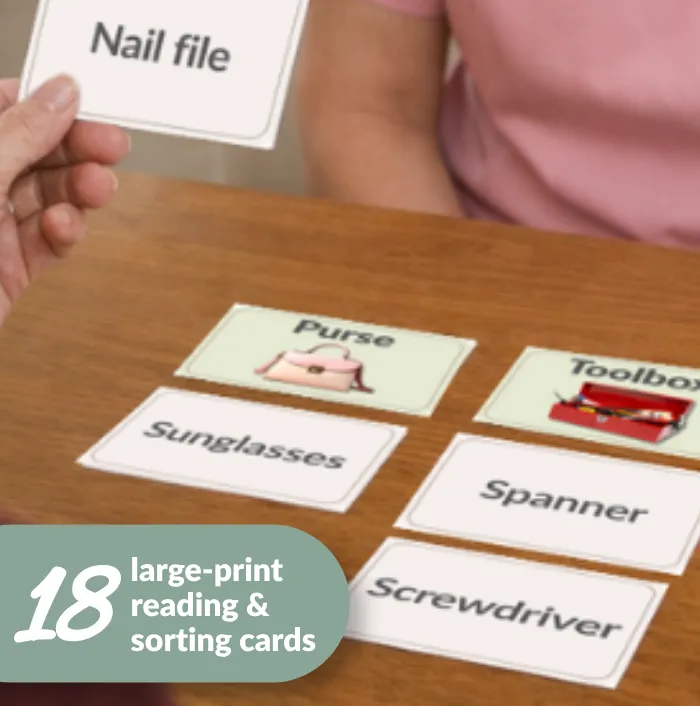
Purse or Toolbox? is a printable word sorting activity for people living with dementia that combines large-print reading with familiar everyday knowledge.
The idea is simple. Each card contains the name of an everyday object, and the person decides where it belongs:
Purse or Toolbox?
Lipstick might go under Purse. A hammer might go under Toolbox.
There's no need to recall a fact, date or name from the past. Instead, the activity draws on something much more familiar: knowing where everyday things belong.
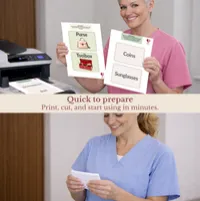
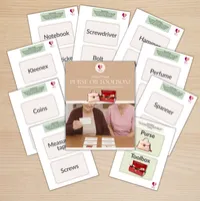
With large 72-point print, just two categories and cards that can be physically picked up and placed, the activity provides a straightforward way to read, sort and participate.
Who might enjoy this word sorting activity?
Purse or Toolbox? may suit someone who:
can still read familiar words
enjoys sorting or organising things
has used tools or enjoyed practical work
has enjoyed handbags, accessories or getting ready to go out
responds well to simple hands-on activities
enjoys doing something together rather than being asked lots of questions
The categories may also spark recognition, comments or conversation about familiar objects and experiences.
But conversation isn't required for the activity to be worthwhile.
How does Purse or Toolbox? work?
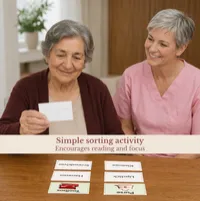
Place the two large heading cards — Purse and Toolbox — on the table.
Give the person one word card at a time and invite them to decide where it belongs.
For example:
perfume → Purse
spanner → Toolbox
They can read the word, hold the card and place it beneath the category they choose.
Start with just a few word cards
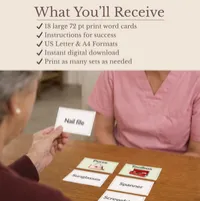
There's no need to use all 16 words at once.
Start with a few very different examples and demonstrate the activity if needed.
You might read the word aloud and say:
“Where shall we put this one?”
If the person understands the idea and seems to enjoy it, introduce some more cards.
Give the person something to hold
This is one of the ideas that originally attracted me to the work of dementia educators Tom and Karen Brenner.
Their Montessori-inspired reading activities use large-print cards that people can physically hold rather than expecting someone to produce an answer “out of thin air.” Their Category Sort activities include the idea of sorting things found in a toolbox from things found in a purse.
I've built on that idea in Purse or Toolbox?, using large, clear word cards and simple caregiver instructions to create a ready-to-print activity.
Why use words rather than pictures?
This is an important feature of this particular Sylvia's Heart activity.
Apart from the two illustrated heading cards, the sorting cards contain words rather than pictures.
That means the person can use their remaining reading ability while also drawing on familiar knowledge about everyday objects.
Someone may find deliberate recall increasingly difficult and yet still know that a hammer belongs in a toolbox or perfume belongs in a purse.
The activity doesn't require them to explain how they know.
They can simply read, decide and place the card.
What if sorting the words is too difficult?
Make the activity smaller.
Use only a few cards. Read a word aloud if that helps. Demonstrate where one card might go and then offer another.
And don't turn an unexpected answer into a correction exercise.
There may even be a story behind a choice that doesn't make sense to you.
The Brenners describe a wonderful example from one of their Category Sort activities in which a farmer passionately argued that a tractor belonged in the “living” category because of his relationship with the tractor he'd worked beside for years. Their point was that the exercise could lead somewhere much richer than simply obtaining the expected answer.
You may also like

Customer Reviews

Write a review
Be the first one to review this product

© 2026 | Powered by Freedomkit.ai